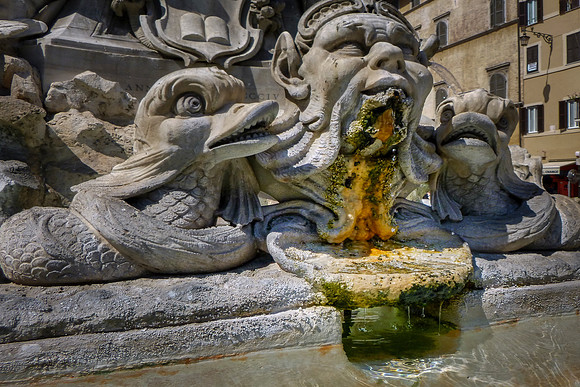
Marble Angels & Dolphins
This captivating photo, taken in Piazza della Rotonda in Rome, focuses on a detail from the majestic Fontana del Pantheon. Adorned with intricate marble angels and dolphins, the fountain exudes timeless elegance against the backdrop of the Pantheon Obelisk. Vibrant hues of green and yellow, accentuated by the elements in the water, infuse the marble with a mesmerizing allure. Shot on an iPhone 7 during a beautiful summer afternoon, this image encapsulates the artistic mastery and historical significance of Rome's architectural marvels, evoking a sense of awe and wonder. Created by the sculptor Leonardo Sormani, on a 1575 design by the architect Giacomo della Porta, the fountain of the Pantheon was one of the first fountains erected in Renaissance Rome. It was built following the restoration of the Vergine aqueduct which supplies, among others, the Fontana della Barcaccia, the Trevi Fountain and the Fountain of the Four Rivers.
Originally it consisted of a mixed-line basin in African gray marble, with the sides interrupted by four circular arches and was surmounted by a baluster supporting a basin. Four masks were inserted into the handles of the semicircles, on the back of which were depicted dragons, heraldic symbols of the Pope Gregory XIII Boncompagni. An external balustrade and three steps surrounded the pool. Of the Della Porta complex, however, only the gorgeous marble basin remains today, as the fountain has been gradually transformed by a series of interventions.
In 1662, the floor of the square was lowered, the balustrade and the steps were removed and was built a large base that incorporates the mixtilinear motif of the basin.
In 1711, by the will of the Pope Clement XI Albani, the central obelisk of Ramses II, coming from Iseo Campense and transported here from nearby Piazza San Macuto, was added in place of the upper basin. Supported by a complex sculptural base, the work of Filippo Barigioni, the obelisk rises on a false travertine cliff, on which a